
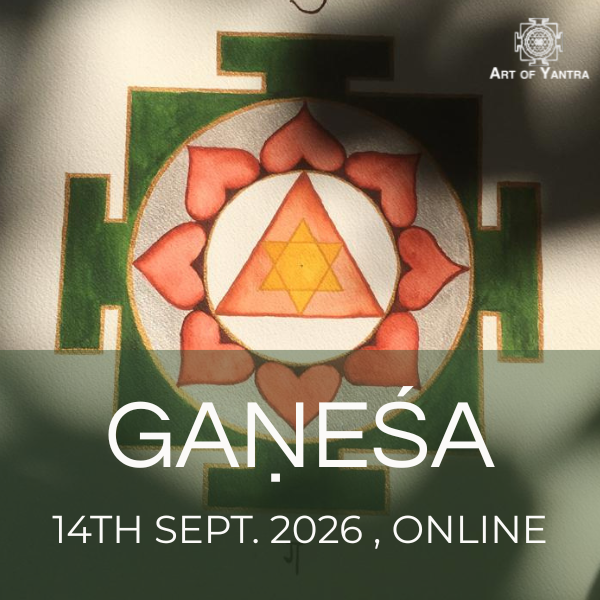
Thank you for joining the Gaṇeśa live-online class!
Date: Monday, 14th September 2026
Time: 7–10:30 pm (CEST). You can check your time-zone here.
Link for zoom-meeting for Ganesha Mantra and Yantra class
Meeting-ID: 826 8590 3713
Kenncode: ganesha
Please find the information below to help you prepare for the class.
I recommend bookmarking this page so you can easily return to the class-link.
If you have any questions, please don’t hesitate to contact me at om@artofyantra.com.
If you haven’t already, you’re warmly invited to subscribe to my newsletter to receive updates about upcoming courses, retreats, and new mantra and yantra offerings.
Looking forward to seeing you in class.
om tat sat
Antarshuddhi
Ganesha Chaturthi – Ganesha’s Birthday Celebration
We are gathering on Gaṇeśa Caturthī, which marks the traditional celebration of Gaṇeśa’s birth and is one of the most widely observed festivals in India. Known for his elephant head and rich symbolism, Gaṇeśa is associated with new beginnings, wisdom, discernment, and the ability to navigate obstacles and challenges.
The festival begins on 14th September and concludes on 25th September with the immersion of Ganesha images in water, accompanied by processions, music, and celebration. This ritual symbolises the cyclical nature of creation, dissolution, and renewal.
At the beginning of the festival, we will create the Gaṇeśa Yantra and explore its symbolism through mantra and meditation. You can then continue your practice with the yantra throughout the festival, using it to cultivate focus, steadiness, and purposeful intention.
A yantra is a sacred geometric form that embodies the manifested energy of a mantra. Together, yantra and mantra serve as powerful tools for meditation and transformation, helping us expand our awareness and align the microcosm (inner world) with the macrocosm (universal energy).
Through sound and form — mantra and yantra — we create a simple, practical ritual to focus the mind, awaken creative and spiritual energy, and support personal transformation.
Materials for the Session
You can find an art supplies check list for the materials you will need for our session here. You might also need gold gouache paint in a tube or pan if you like using metallic colours.
What You Need to Know Before the Session
Gaṇeśa is traditionally associated with mūlādhāra-cakra, the root centre, which in yogic philosophy represents stability, grounding, and the foundation from which all practice develops. As the guardian of this centre, Gaṇeśa is traditionally invoked at the beginning of rituals, journeys, and new undertakings, symbolising the importance of establishing a steady foundation before moving forward.
His iconography reflects many qualities that are valuable both in practice and in daily life: wisdom, discernment, patience, adaptability, and the ability to approach challenges with clarity rather than resistance. For this reason, Gaṇeśa has long been regarded as the deity who prepares the way for learning, creativity, and transformation.
In this online workshop, we will explore the Gaṇeśa Yantra through mythology, iconography, mantra, and sacred geometry. We will look at the principles of how mantra and yantra work together as complementary tools for meditation, concentration, and self-reflection, while deepening our understanding of Gaṇeśa’s symbolism and its relevance to both traditional practice and everyday life.
The weekday traditionally associated with Gaṇeśa is Wednesday.
When placed in a chosen space, the yantra can serve as a visual focal point for meditation and personal practice, supporting steadiness, clarity, and purposeful intention.
A few words for your preparation
Your pūjā space:
During the session, we are drawing the Gaṇeśa Yantra, an act of devotion and meditation in itself. You are warmly invited to create a small pūjā space (altar) before you start the practice – whatever feels natural and accessible to you. Even a single flower, a candle, some incense, or the gentle ringing of a bell can transform your space into a sacred one. These outer rituals are gateways to inner experience.
Colours:
The colours of Gaṇeśa are yellow, gold, orange, red and green. If you wish, you may wear clothing in these colours, and any flowers you offer can also reflect these tones.
Practice before the session:
If you wish, you may practice include a few rounds of grounding and balancing āsana and prāṇāyāma practices before the session.
Pūjā practice for initiating the drawing:
As yantra practice is closely connected to rituals we will perform a very simple pūjā together. If you feel inclined to join the pūjā, please prepare the following items: a plate containing small bowls with: water (spring water if available), rice mixed with sesame seeds (you may also add a few flower petals), yellow sweet offering, a ghee or sesame oil lamp, incense and an incense holder, a yellow flower and a bell.
Please don’t worry if you are unable to gather all the items. You are welcome to join the practice with whatever is available to you.
Orientation:
If possible, try to sit facing East with your pūjā setup in front of you. If that is not practical, please don’t worry – come as you are. It is the sincerity of your intention that matters most.
Saṅkalpa:
It is considered a particularly auspicious time to make a personal saṅkalpa – a quiet resolve or heartfelt intention – to deepen your sādhana or dedicate yourself to a meaningful goal, to cultivate wisdom, discernment, steadiness, and the confidence to navigate life’s challenges.
By connecting with the mantra’s vibration, tuning into the Sun’s radiance, and opening ourselves to the illuminating power of Gaṇeśa, we can cultivate these qualities within and bring them more fully into our lives.
Mantras:
The mantras we chant together are listed in the PDF attached. This is a simple yet potent way to connect with the energy of Gaṇeśa – through your voice, intention, heart, and presence.
Mala:
While we are chanting the mantras, you may want to count with your mala, so you can keep it close at hand. For Gaṇeśa is recommended a rudrākṣa or red sandal wood beeds mala.